Tiếng Việt

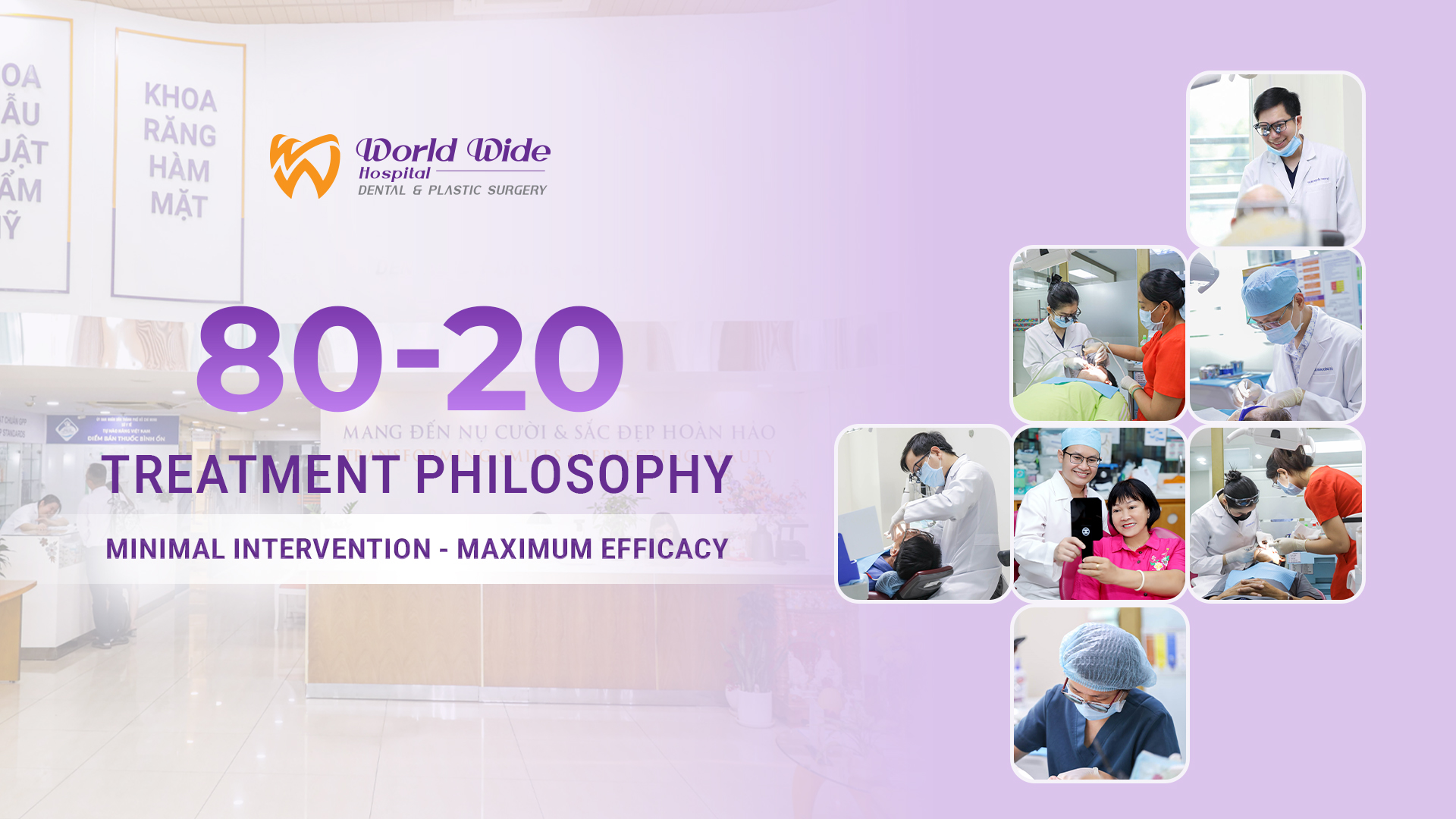
Discover the 80-20 treatment philosophy at Worldwide Dental Hospital: prioritizing natural tooth preservation, minimal intervention, and long-term efficacy.
In modern dentistry, a successful clinical outcome is measured not merely by aesthetic enhancement or restored masticatory function, but by the extent to which healthy natural tooth structure is preserved.
This principle lies at the heart of the 80-20 treatment approach: rather than resorting to extensive intervention to produce dramatic transformations, clinicians focus on identifying the specific pathology requiring treatment, preserving maximum natural anatomy, and applying targeted techniques to achieve optimal outcomes.
In other words, the goal is never “doing as much as possible,” but delivering the precise level of intervention – at the right site – with the correct clinical indication, ensuring results that are not merely aesthetically pleasing today, but functionally sustainable for years to come.
What Is the 80-20 Treatment Philosophy?
Not a Rigid Formula
The 80-20 concept in dental care should not be misconstrued as executing only 20% of a procedure to achieve an 80% outcome, nor is it a rigid formula applied uniformly across all patients.
Instead, it represents a conservative treatment philosophy. Clinicians prioritize the preservation of healthy tooth structure, soft tissue, and biological foundations, intervening only where strictly necessary.
The exact scope of intervention remains dependent on each patient’s unique clinical presentation.
Minimally Invasive Does Not Mean Undertreating
Practicing minimally invasive dentistry does not equate to simplifying clinical workflows or overlooking underlying issues.
On the contrary, achieving superior results with “less intervention” demands sharper diagnostic accuracy, meticulous treatment planning, and precision at every clinical step.
While some cases require only minor interventions, advanced pathologies or severe structural damage inevitably necessitate specialized, comprehensive procedures.
The guiding principle remains clear: never intervene more than necessary, yet never treat less than required.
Why Modern Dentistry Prioritizes Conservative Care
Natural Tooth Structure Is Biologically Irreplaceable
While modern restorative materials have advanced significantly in durability, aesthetics, and biocompatibility, no synthetic material can fully replicate the biological integrity of healthy natural tooth structure.
Consequently, whenever healthy dental anatomy can be preserved, clinicians prioritize its retention rather than sacrificing it for prosthetic convenience.
This marks a vital paradigm shift in modern dentistry: moving away from “damage repair” toward structural preservation and extending the natural lifespan of the dentition.
The Greater the Intervention, the Higher the Long-Term Cost
Every instance of tooth preparation, reduction, or structural removal is entirely irreversible.
Before making any clinical decision, practitioners must look beyond immediate postoperative outcomes and address a critical question:
- What will become of this tooth in 5, 10, or many years to come?
An optimal treatment plan must therefore strike a deliberate balance among aesthetics, function, durability, and long-term biological preservation.
How Is the 80-20 Philosophy Applied in Clinical Practice?
Aesthetic Restorations: Moving Away from Aggressive Tooth Reduction
When patients seek to enhance their smile, the objective should not merely be creating uniform and bright teeth.
Selecting an appropriate approach requires an evaluation of tooth color, morphology, remaining enamel, occlusion, smile line, and facial proportions.
Where clinically indicated, solutions such as veneers or minimally invasive restorations are favored to minimize tooth reduction.
Crucially, no single treatment protocol should be universally applied across every smile.
Implants: Preserving Bone Volume and Soft Tissue Architecture
The minimally invasive philosophy is equally vital in implant treatment.
Utilizing 3D Cone Beam CT imaging and digital treatment planning workflows, clinicians assess residual bone volume, anatomical boundaries, and implant location prior to surgery.
The objective is to establish the ideal three-dimensional positioning, prevent unnecessary trauma to adjacent vital structures, and preserve the underlying bone and soft tissue whenever clinical conditions permit.
In cases of bone deficiency, practitioners will accurately evaluate the extent of the defect to determine whether bone grafting, sinus lifting, or other supportive techniques are necessary, rather than defaulting to additional interventions.
Natural Tooth Treatment: Prioritizing Tooth Retention When Feasible
A compromised tooth does not automatically warrant extraction.
If the long-term prognosis is favorable, clinicians explore conservative therapies to resolve pathology and maintain the natural tooth for as long as possible.
Only when a tooth is non-restorable, or its long-term prognosis unfavorable, should clinicians consider replacement options such as dental implants.
This embodies the essence of the 80-20 philosophy: preserving whatever can be saved, and replacing only what is clinically necessary.

Minimally Invasive Dentistry Demands Deeper Diagnostic Insight
Precise Diagnosis as the Clinical Foundation
To minimize intervention, clinicians must have complete diagnostic clarity before treatment begins.
Depending on the case, comprehensive diagnostics integrate clinical examinations with advanced data sources, including:
- 3D Cone Beam CT scans.
- Digital intraoral scans.
- Occlusal analysis.
- Intraoral and extraoral clinical photography.
- Digital smile designs and predictive restorative simulations.
With complete diagnostic data, clinicians can accurately delineate between compromised tissue requiring intervention and healthy structures that should be preserved.
Technology as a Tool, the Clinician as the Decision-Maker
While advanced technology enhances visualization, simulation accuracy, and procedural execution, digital tools can never replace clinical judgment.
Two patients presenting with seemingly identical clinical conditions may still require fundamentally different treatment strategies.
Ultimately, the definitive factor rests upon the clinician’s diagnostic insight, clinical experience, and treatment philosophy.
When Is Minimal Intervention Not Feasible?
Safety and Treatment Outcomes Remain Paramount
Conservative care does not mean attempting to save compromised teeth at all costs.
In cases of extensive damage, infection, severe bone resorption, poor prognosis, or insufficient tooth structure for restoration, more extensive interventions may be required.
Similarly, in implant dentistry, extensive bone loss often necessitates bone grafting, sinus lifting, or specialized techniques to ensure safe implant placement.
Therefore, “minimal intervention” must always align with an overarching mandate: intervening only to the extent necessary for clinical safety and long-term prognosis.
The Ultimate Value of the 80-20 Approach
The 80-20 philosophy is not about minimizing procedures for the sake of simplicity, nor is it about rushing toward quick aesthetic fixes.
The core value lies in determining the right degree of intervention for each patient.
An exceptional treatment plan resolves immediate dental concerns while strictly avoiding the unnecessary sacrifice of healthy tissue. In dentistry, the natural structures preserved today form the foundation of oral health and stability for decades to come.
This is precisely why the principle of “minimal intervention, maximum efficacy” has become a cornerstone of modern, patient-centered dentistry.

The 80-20 Philosophy at Worldwide
Personalized Care Over Standardized Protocols
At Worldwide Dental Hospital, every treatment plan is customized to each patient’s clinical reality.
Rather than starting with the question, “Which procedure should be performed?”, our clinicians first identify the underlying problem that needs to be addressed, the structures that can be preserved, and the long-term goals of treatment.
Only then can the appropriate treatment approach be selected, taking into account clinical, functional, and aesthetic considerations.
A Multidisciplinary Ecosystem Supporting Comprehensive Decisions
Complex dental cases rarely fall under a single specialty.
Patients may present concurrently with occlusal, periodontal, restorative, or implant-related issues. Multidisciplinary collaboration among our specialists ensures comprehensive treatment planning, avoiding the isolated management of individual issues while overlooking their impact on the oral system as a whole.
In addition to our specialist team, Worldwide integrates advanced digital diagnostics, an in-house CAD/CAM dental laboratory, and hospital-grade surgical facilities to support the entire treatment continuum from initial diagnosis to definitive restoration.
Conclusion
An aesthetically pleasing result is never truly optimal if it requires the excessive sacrifice of healthy tooth structure.
The 80-20 treatment philosophy centers on diagnostic accuracy, structural preservation, and highly targeted clinical intervention – achieving the perfect harmony among aesthetics, function, and the long-term preservation of natural dentition.
At Worldwide Dental Hospital, each treatment plan is personalized to the individual case through multidisciplinary expertise and modern technological support.
If you are considering aesthetic restorations, dental implants, or advanced dental care, schedule a consultation at Worldwide Dental Hospital for a comprehensive evaluation and a conservative, safe, and sustainable solution.